Breath is the essence of life. Drawing is the essence of painting. Typography is the essence of design. Poetry is the essence of literature.
Allah Hu Akbar (Allah is the Greatest)
Allah Hu Akbar
The call to prayer reverberates over the desert sands and city streets of Saudi Arabia. In the desert the feeling of solitude and quiet, the blanket of stars in an ultramarine sky embraces prayer, while in the city the hustle and clanging of bells and horns, hawkers voices calling for business, requires another kind of dedication. Within the struggle of the traditional to merge with the modern stands the current dilemma of balancing life. Jalaluddin Rumi, the thirteenth century Sufi poet and mystic said: “What kind of prayer is this, when my heart is in the mosque and my mind is in the bazaar.”
Ash-hadu an la ilaha illa’Llah
(I bear witness that there is nothing worthy of worship but Allah.)
Ash-hadu an la ilaha illa’Llah
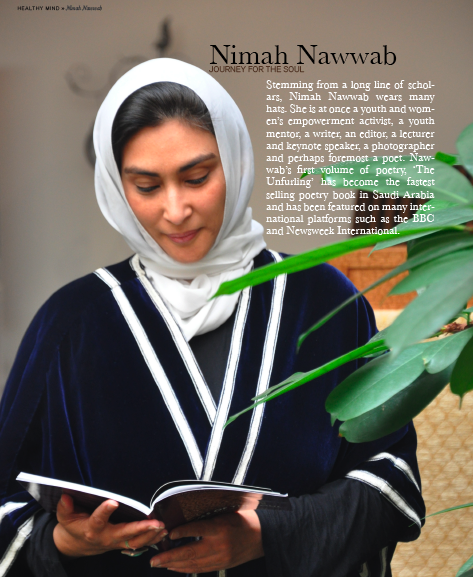
Amidst the traditional and the modern, the desert and the city, the thobe and Gucci, emerges the poetic voice of Nimah Nawwab, born into the lineage of a family of scholars in Makkah. Her poems remind us of the traditional, remind us to remember, remind us to invoke His Name, be it in solitude or in the marketplace.
Ash-hadu anna Muhammadan Rasool Allah
(I bear witness that Muhammad is the Messenger of Allah.)
Ash-hadu anna Muhammadan Rasool Allah
Nawwab has understood, and deftly relates through her poems, the love secreted beneath the skin of one’s own dreams and unkept promises. Promises written on the pages of the Book of Man. A constantly changing book that reveals its meaning according to the understanding of the reader. Her poems unfold the living landscapes, the horizons that hold the signs spoken of in the [Koran] Qur’an. The calligraphy of the mountains dipping into the desert, the inkwell of God’s words, reflecting the signs before us into the secrets within the Book of Man. This book that has no beginning and no end; this book that is on loan to each and everyone, be they man, woman, or child.
Hayya ‘ala as-Salat, Hayya ‘ala as-Salat (Hasten to Prayer)
Hayya ‘ala as-Falah, Hayya ‘ala as-Falah (Hasten to Success)
Nawwab’s poems speak of the light, the light upon the light, the light within the light, the LIGHT, noorun ‘ala noor, the light on the palm of the Prophet Moses revealing the Name of God. Her poems speak of the need to invoke His Name, to realize that every action begins with the hand, upon which is written His Names, so that we may complete the Book of Man, our purpose for being here.
A Sufi sheikh likened prayer and its movements to the reading of the Book of Man. Read. One bows in humility. You are faced with your sins, and your head touches the ground. Allah’s greatness is acknowledged and you rise again. And again you are faced with the box of your actions and you bow and place your head to the ground. His Name is breathed and you stand upright.
Nawwab’s first published book of poems, “The Unfurling” includes pieces which have been translated into several languages and she became a voice for Arab youth and women. Hers was the first book by a Saudi poet to be published in the U.S. Her interests reach farther than her words. They entwine theatre, music, photography and film. She is determined to invest Saudi youth with an understanding of their own culture, as well as being a bridge to western culture.
“Canvas of the Soul: The Mystic Poems from the Heartland of Arabia,” addresses the balance of the inner freedom of one’s soul and poses questions of stability between a serene state and walking the tightrope of today’s rapidly changing society. Within these pages, scribbled with the inner thoughts of a concerned Arab woman, are seeds of a future being planted now.
Allah Hu Akbar, Allah Hu Akbar (Allah is the Greatest)
La ilaha illa’Llah (There is nothing worthy of worship but Allah)
La ilaha illa’Llah
Shems Friedlander
Shems Friedlander graduated from the Massachusetts College of Art in 1963 and since then has been prominent in the art world as a photographer, graphic designer, documentary filmmaker and painter. He is the author of nine books and his work has been exhibited worldwide. Friedlander teaches visual communications, drawing, painting and photography at the American University in Cairo.


 Arabia Middle East Writing Poetry Youth Women